Noticias
Is Joint Pain an Unavoidable Menopausal Hurdle? This Natural Compound May Hit the "Brakes"
2026-03-06 10:36:54
Visitas:0
“
Among women over 50, the prevalence of osteoarthritis is as high as 22%, nearly double that of men in the same age group.Who is the primary culprit? Estrogen.The sharp decline in estrogen after menopa
”
Among women over 50, the prevalence of osteoarthritis is as high as 22%, nearly double that of men in the same age group.
Who is the primary culprit? Estrogen.
The sharp decline in estrogen after menopause means the articular cartilage loses its lubrication and protection, accelerating wear and tear. However, hormone replacement therapy carries risks, including breast cancer, leaving many in a dilemma.
This is where S-Equol, the "final metabolite" of soy, has garnered scientific attention.
It is more stable and bioactive than common soy isoflavones. But here's the catch: not everyone can produce it. Only 25%-30% of Western populations can produce S-Equol after consuming soy products; the rate is slightly higher in Asia, but still only 50%-60%.
So, what
The research suggests: Yes, it can, and the evidence is steadily accumulating.
A research team has, for the first time, systematically confirmed in an animal model that S-Equol supplementation (at 2 mg/kg, equivalent to the converted human recommended daily dose) has a protective effect against menopausal osteoarthritis of varying severity. Let's re-examine the chain of evidence:
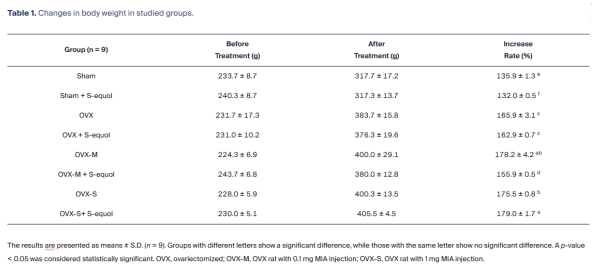
Step 1: Improving the Systemic Metabolic Environment
Menopausal women often face weight gain and dyslipidemia, which can exacerbate joint burden. The study showed that S-Equol reduced body weight (Table 1) and serum triglyceride levels (
Step 2: Protecting Articular Cartilage Structure
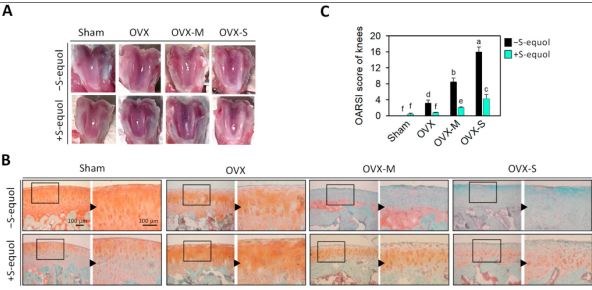
Visual observation and tissue staining provide the most direct evidence. After S-Equol supplementation, the articular cartilage surface in rats appeared smoother, the loss of Safranin O staining (representing proteoglycan content in cartilage) was reduced, and the OARSI histological score was significantly lowered (
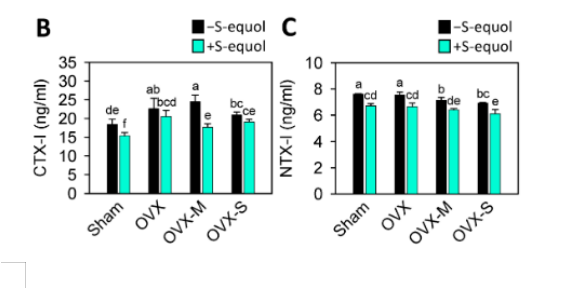
Step 3: Inhibiting Bone Resorption, Stabilizing Subchondral Bone
Osteoarthritis isn't just
Step 4: Reducing Cartilage Matrix Degradation
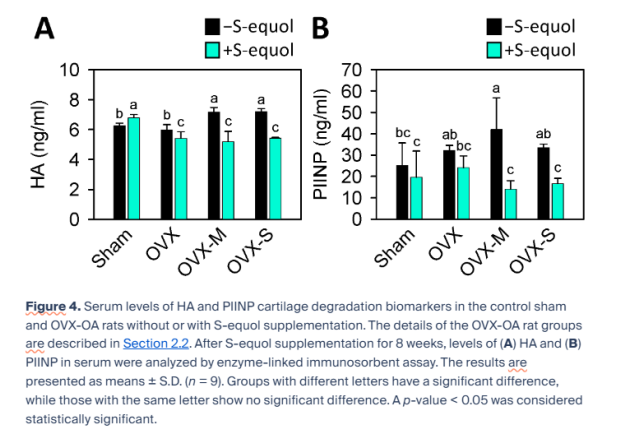
The decrease in cartilage degradation markers HA and PIINP (
Step 5: Scavenging Oxidative Stress
Oxidative stress is one of the drivers accelerating joint aging after menopause. S-Equol reduced levels of H₂O₂ and NO (
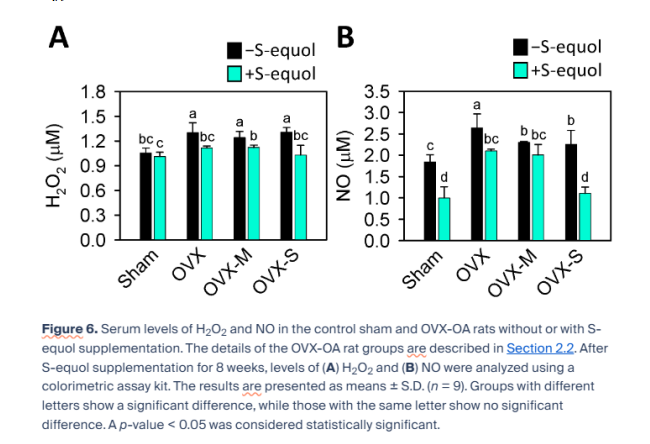
From body weight and blood lipids to cartilage structure, degradative enzyme activity, and oxidative stress – S-Equol hits the "brakes" on menopausal osteoarthritis progression at multiple points.
Of course, whether the results from animal studies can be fully replicated in humans requires validation through more clinical research. But at least the pathway is clear: For women unable to produce sufficient S-Equol naturally (70%-75% in Western populations, 40%-50% in Asia), direct S-Equol supplementation might be a worthwhile option to consider.
This study extends its protective scope from osteoporosis to osteoarthritis – from bone to joint, this piece of the soy "puzzle" is gradually being filled.
In the future,
Source:
Hu, Yu-Chen, Tzu-Ching Huang, Li-Wen Huang, Hsiao-Ling Cheng, Bau-Shan Hsieh, and Kee-Lung Chang. 2024. "S-Equol Ameliorates Menopausal Osteoarthritis in Rats through Reducing Oxidative Stress and Cartilage Degradation" Nutrients 16, no. 14: 2364. https://doi.org/10.3390/nu16142364
Autor:
admitir

Haga clic en la esquina superior derecha
compartir con amigos







 Mantenga presionada la imagen para guardar/compartir

Desde su creación, la empresa se ha adherido a un enfoque centrado en las personas con un enfoque central en la salud humana y un compromiso con la innovación continua como ventaja competitiva. Se ha concentrado constantemente en la investigación científica de vanguardia en la industria global de la salud y el bienestar.
Navegación del sitio
Contacto
Dirección: Edificio 21, Yinfeng International Bio-city, No. 1177 Chunlan Road, Jinan, Shandong China Código postal: 250100 Teléfono de contacto de comercio nacional: +86-18980869808 +86-19854163113 Correo electrónico: info@yltnutra.com Teléfono de contacto del departamento de comercio internacional: +86-17778451219 +86-18980869808 Correo electrónico:jennyy@yltnutra.com
Suscríbete a nosotros
Ingrese su dirección de correo electrónico para nuestra lista de correo para mantenerse actualizado.

© 2026Shandong Yuanlitai Medical Technology Co. Ltd. . All rights reserved Lu PCI No. 2022033305 mapa del sitio